Castings, foundries, and the old truths modern industry depends on
Casting is one of the clearest examples of a forgotten industrial truth: advanced manufacturing does not replace foundational manufacturing. It depends on it.
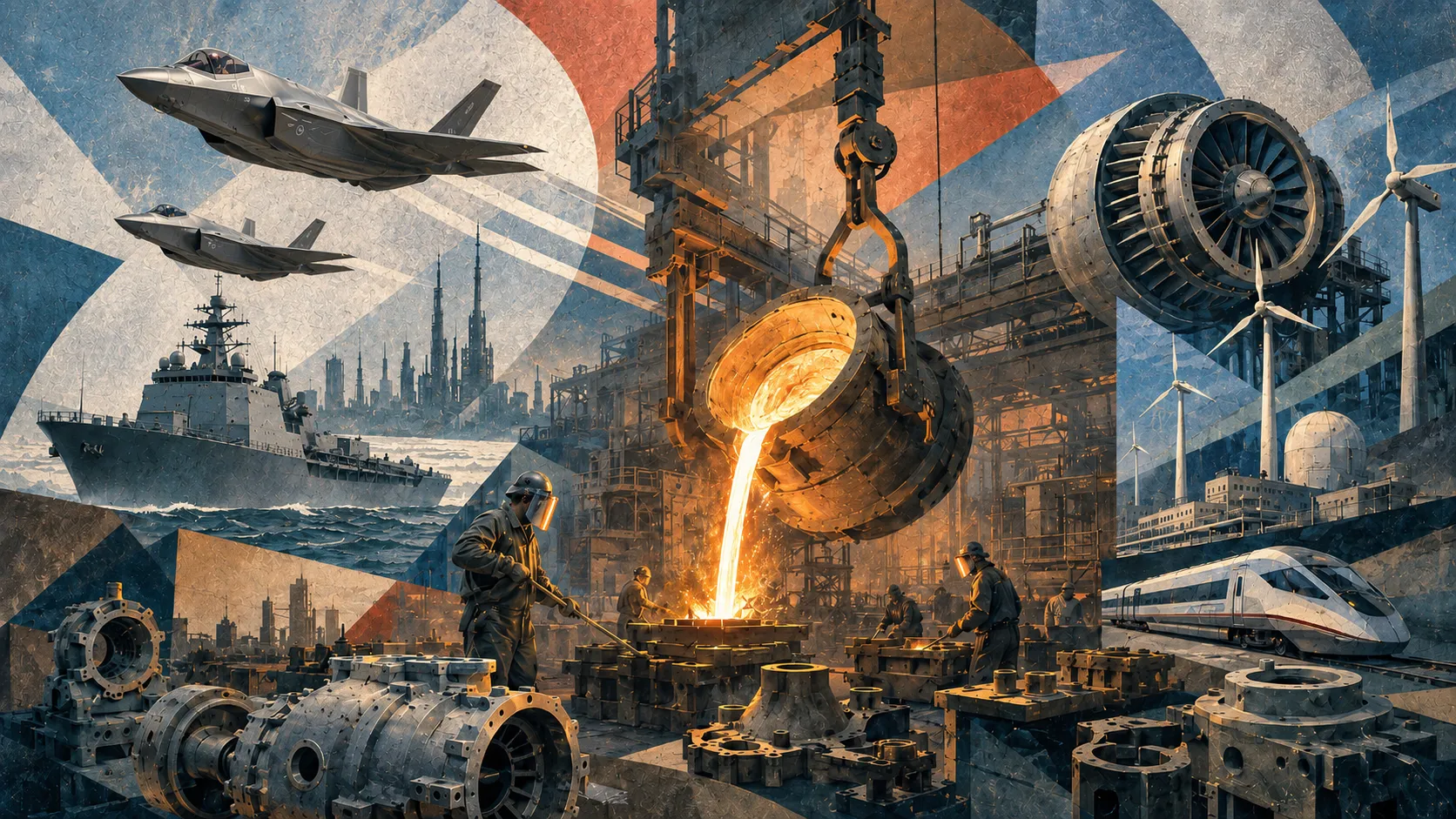
A missile, a submarine, an aircraft engine, a rocket system, a hydraulic pump, a turbine, an industrial valve, or a landing gear assembly may look like precision engineering by the time it reaches the prime contractor. But much of it begins earlier, in places people do not usually associate with the future: foundries, forge shops, heat treat facilities, pattern shops, machine shops, inspection labs, and welding bays.
No one launches a product by saying, “look at our pump housing.” No one gives a keynote about a valve body. But the physical world is full of parts like these. The American Foundry Society says metalcasting is a $51 billion U.S. industry, directly employing more than 160,000 people and indirectly supporting more than 300,000 additional supply-chain jobs.
Roughly 90% of manufactured durable goods contain castings.¹
So…castings are everywhere, but almost invisible.
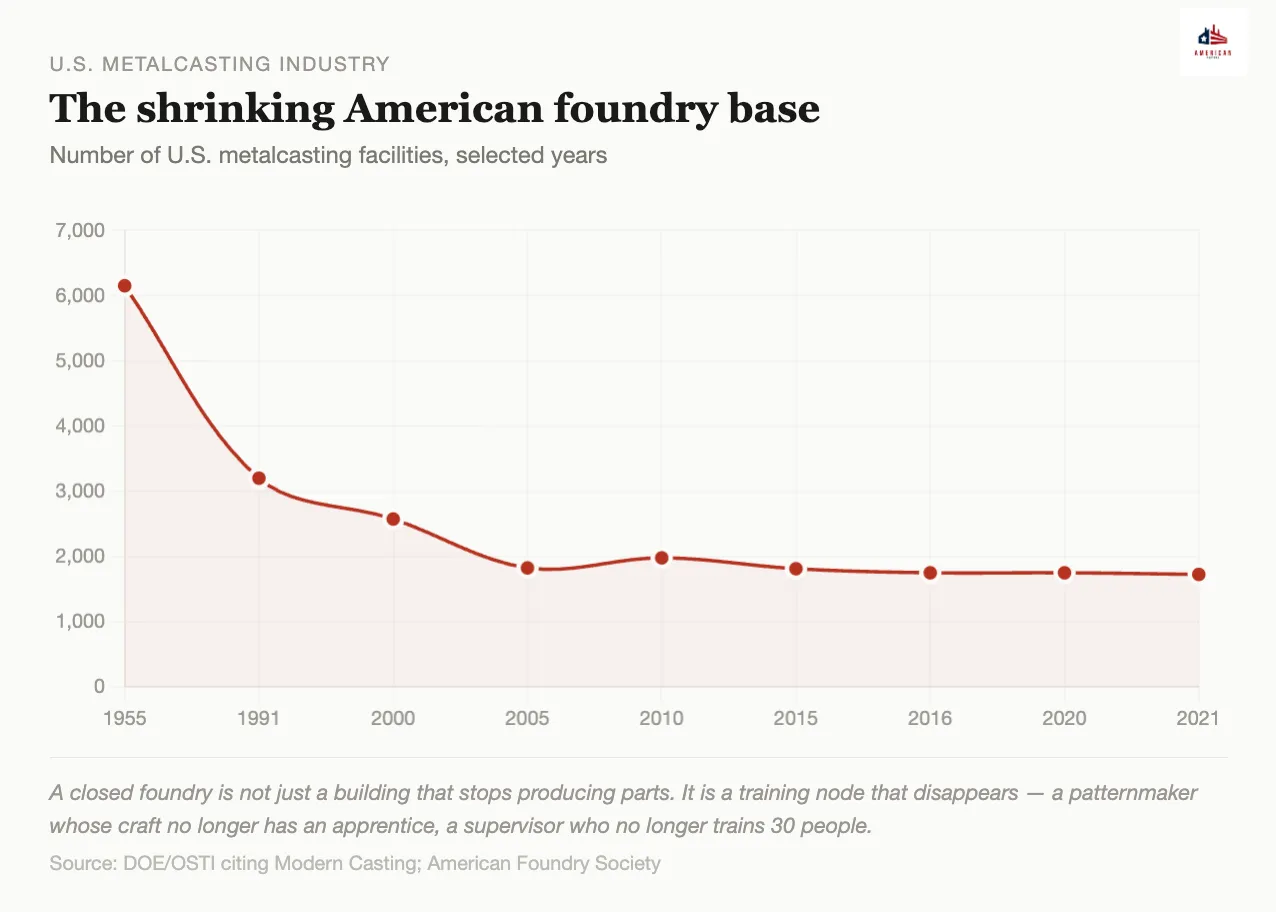
And the industry is shrinking. The U.S. has about 1,750 metalcasting facilities today. In 1991, it had 3,200. In 1955, it had 6,150.² Some of that decline is consolidation. Some of it is productivity. But some of it is simply the disappearance of places where people knew how to turn molten metal into useful things.
Newsflash: the decline of foundries is not evidence that casting is an outdated industry we no longer need. It is almost the opposite. We need this capability now more than ever.
We talk about the future of manufacturing as if it is mostly robotics, AI, autonomy, software, additive manufacturing, and digital twins. All of that matters. But none of it floats in the air. It sits on top of an older industrial base: metallurgy, tooling, mold-making, melting, pouring, forging, heat treatment, machining, non-destructive testing, dimensional inspection, maintenance, repair, and process knowledge.
Calling these “legacy” skills makes them sound optional, like something left over from a slower era. They are not. They are the base layer. Lose the people who know how to melt, form, treat, machine, inspect, and certify metal, and the advanced stuff above it starts to get fragile.
An airplane is a good example. The question is not whether America can design one. The question is whether we still have enough foundries, forges, heat treaters, machine shops, inspectors, and skilled workers to make all the parts that let it fly.
The government is starting to wake up. The Department of War has identified castings and forgings as a critical defense industrial base vulnerability. Its METAL initiative was created specifically to rebuild the casting and forging workforce through training, apprenticeships, boot camps, and metallurgical education. DoW has also backed efforts like ICON, a portal that helps connect U.S. casting, machining, and forging firms to defense-part opportunities.¹
The point is simple: casting and forging are no longer background industries. They are becoming strategic industries again.
To understand why, here’s a short primer on the history of casting and forging.
The Industrial Process We Forgot Was Strategic
Casting is ancient. Humans have been pouring molten metal into molds for thousands of years. Swords, bells, cannons, statues, tools, pipes, engines, pumps, valves, turbines, machine tools, locomotives, ships, aircraft.
Every industrial era has had its own version of the foundry.
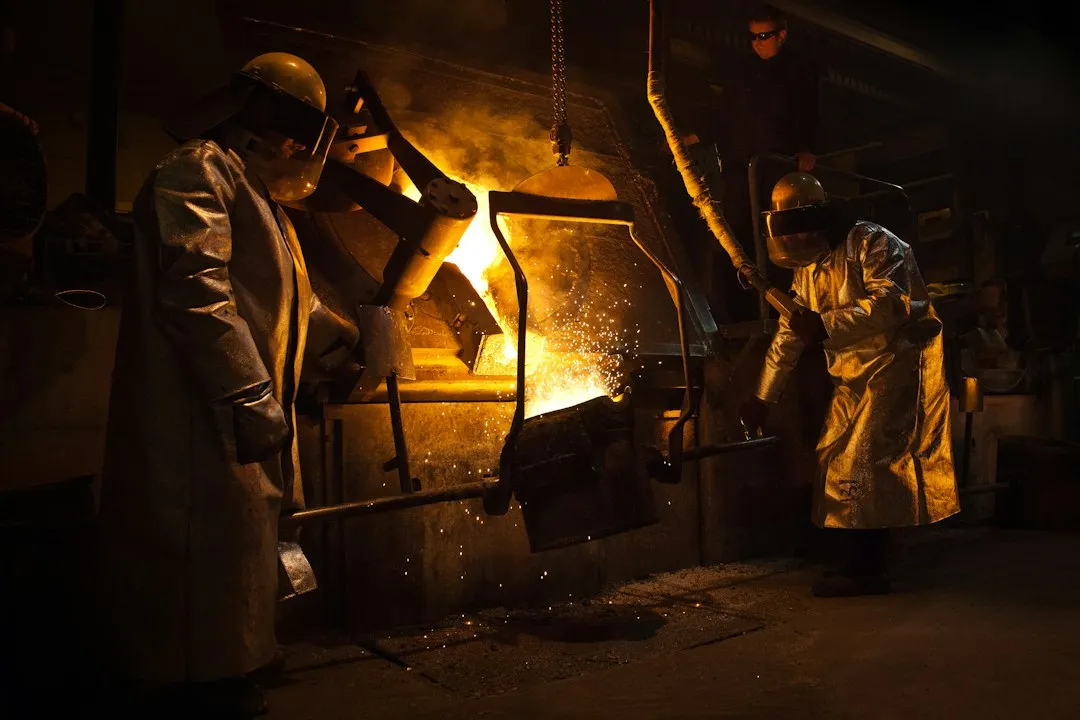
Photo by Olav Ahrens Røtne on Unsplash
Age can fool you. Some old processes survive as habit. Others survive because physics keeps asking the same question: how do you turn raw material into a useful shape?
Casting belongs in the second category.
We still need parts that carry load, hold pressure, manage heat, survive wear, and resist fatigue. We still need shapes that would be too expensive, too wasteful, or too difficult to machine from a solid block. We still need metal to become specific before the rest of the industrial world can build on it.
For much of the twentieth century, foundries were part of America’s industrial geography. They sat near machine shops, shipyards, engine plants, rail suppliers, steel mills, pump and valve makers, automotive suppliers, heavy-equipment manufacturers, and defense production. A place with foundries usually had the surrounding trades too: machinists, welders, patternmakers, toolmakers, maintenance techs, inspectors, metallurgists, and supervisors who understood metalworking as a local language.
Then the network thinned.
One order moved offshore. One apprenticeship program ended. One foundry closed. One customer qualified a foreign supplier. One local school stopped teaching shop. One retirement went unfilled. None of these decisions looked catastrophic by itself. Together, they changed the map.
The aircraft program still existed. The prime still had the contract. The CAD files were still there. But somewhere underneath the program, there were fewer domestic foundries, fewer heat treaters, fewer patternmakers, fewer machinists, fewer inspectors, and fewer people who knew how to fix the process when it drifted.
That is how industrial knowledge disappears. Slowly enough that people can pretend nothing happened, then suddenly enough that a missing supplier becomes a national problem.
Industrial capability compounds. So does industrial decay.
What Casting Actually Is
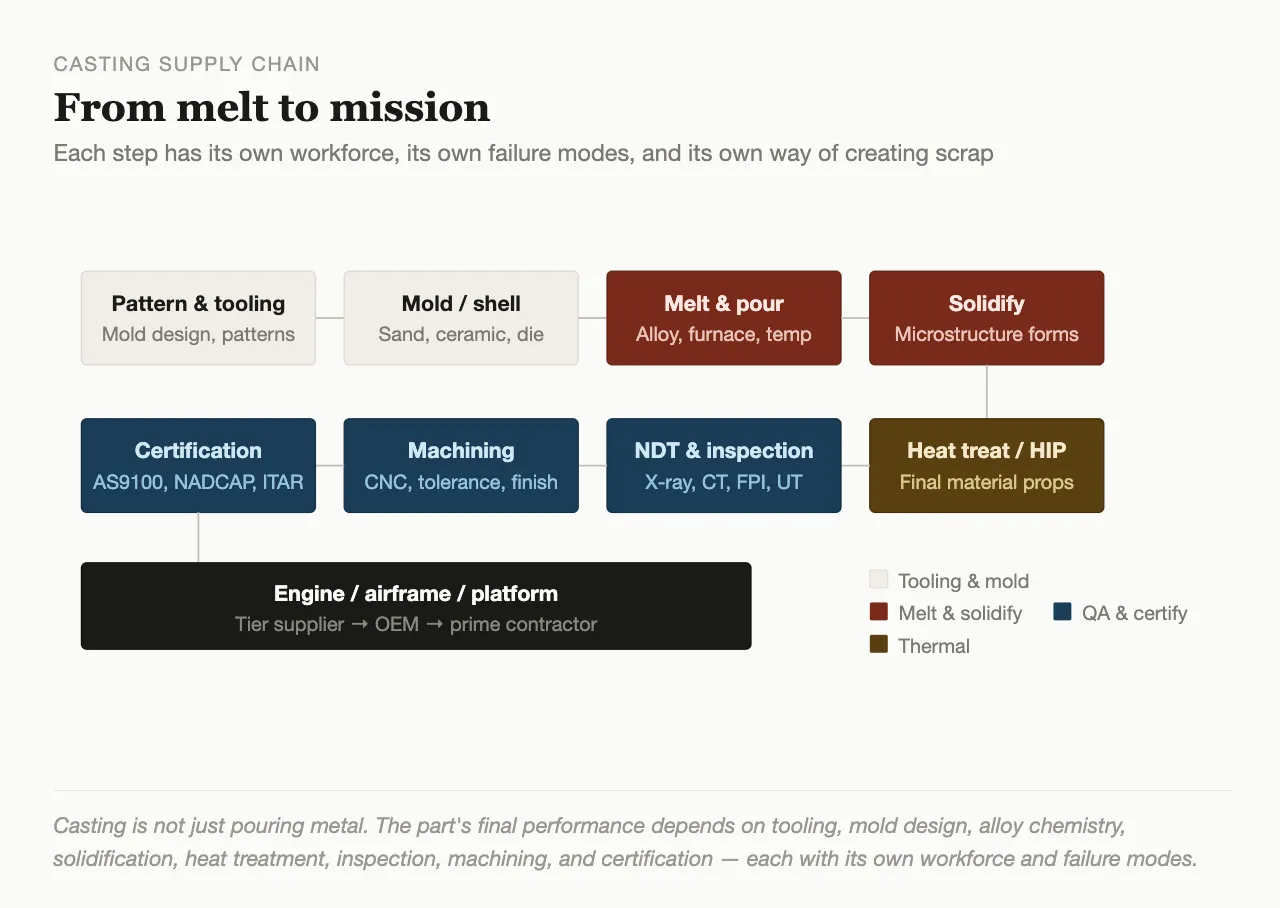
Casting sounds simple because the verb is simple: pour molten metal into a mold. The process is more specific. Casting turns metal into shape before machining ever begins. The method you choose affects the metal, the geometry, the cost, the tolerances, the defects, the inspection, and the skills needed on the floor.
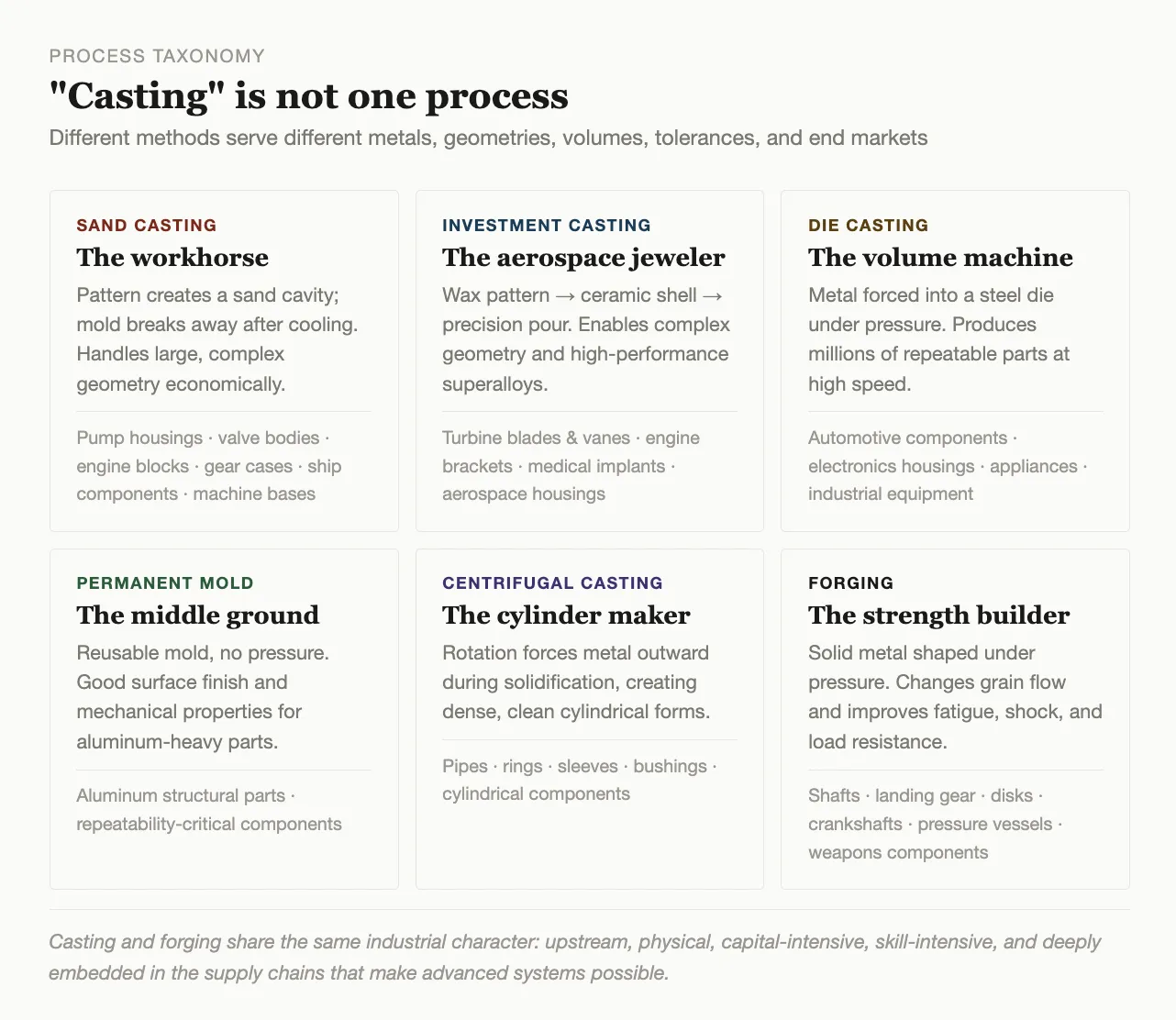
Sand casting is the old industrial default. A pattern creates a cavity in sand. Molten metal fills the cavity. Once the part cools, the mold is broken away. This is how foundries make pump housings, valve bodies, gear cases, machine bases, engine blocks, heavy-equipment components, ship parts, and other large parts where machining everything from solid billet would be too expensive or impractical.
Investment casting starts with wax. A wax version of the part is made, coated in ceramic, and heated until the wax melts out. The remaining ceramic shell becomes the mold. Steel, aluminum, titanium, cobalt, or nickel-based superalloys can then be poured into it. Aerospace depends heavily on this process because it can produce complex geometry, good surface finish, high material performance, and lower weight. Turbine blades, vanes, shrouds, brackets, housings, engine components, and medical implants often come from this world.
Die casting is built for volume. Molten aluminum, zinc, or magnesium is forced into a steel die under pressure. Automotive components, electronics housings, appliances, industrial equipment, and repeatable parts made by the thousands or millions often come from die casting.
Other methods fill in the map. Permanent mold and low-pressure casting are common for aluminum parts where repeatability and surface finish matter. Centrifugal casting uses rotation to make pipes, rings, sleeves, bushings, and other cylindrical parts. Continuous casting turns molten metal into billets, blooms, and slabs that feed rolling mills, forge shops, machine shops, and the rest of the industrial base.
Forging sits next to casting in the metalworking stack. Casting makes shape by pouring molten metal into a mold. Forging makes shape by pressing or hammering heated metal into form. The pressure changes the grain structure and often improves strength. Forgings show up in parts that need to survive load, shock, fatigue, and abuse: shafts, disks, landing gear components, crankshafts, pressure vessels, weapons components, and structural parts.
Foundries and forge shops sit near the beginning of the chain, upstream of machining, assembly, and final systems integration. By the time a casting shows up as a “component” in someone’s bill of materials, a lot has already happened: alloy selection, tooling, mold design, furnace control, pouring, cooling, heat treatment, inspection, machining, and judgment.
Judgment matters. Someone has to know how the metal behaves. Someone has to know what a bad pour looks like. Someone has to know when a casting can be saved and when it is scrap. Someone has to know what the drawing says and what the part is trying to become.
Summary on casting below:
Where Castings Show Up
Castings appear wherever metal has to carry load, hold pressure, manage heat, move fluid, survive wear, or take a shape that would be painful to machine from a solid block.
That covers aircraft engines, ships, submarines, missiles, armored vehicles, gas turbines, pumps, valves, compressors, rail systems, mining equipment, construction machinery, power plants, water systems, machine tools, and medical devices.
Most of these castings disappear inside larger machines. A customer sees the aircraft, not the engine case. The ship, not the pump body. The turbine, not the vane. The factory, not the valves and compressors keeping it alive. Foundries make the parts people rarely name but quietly depend on: turbine blades, vanes, actuator housings, hydraulic components, fuel-system parts, pipe fittings, gearboxes, structural brackets, pump bodies, valve bodies, and landing-gear-related hardware.
A turbine blade is the cleanest example.
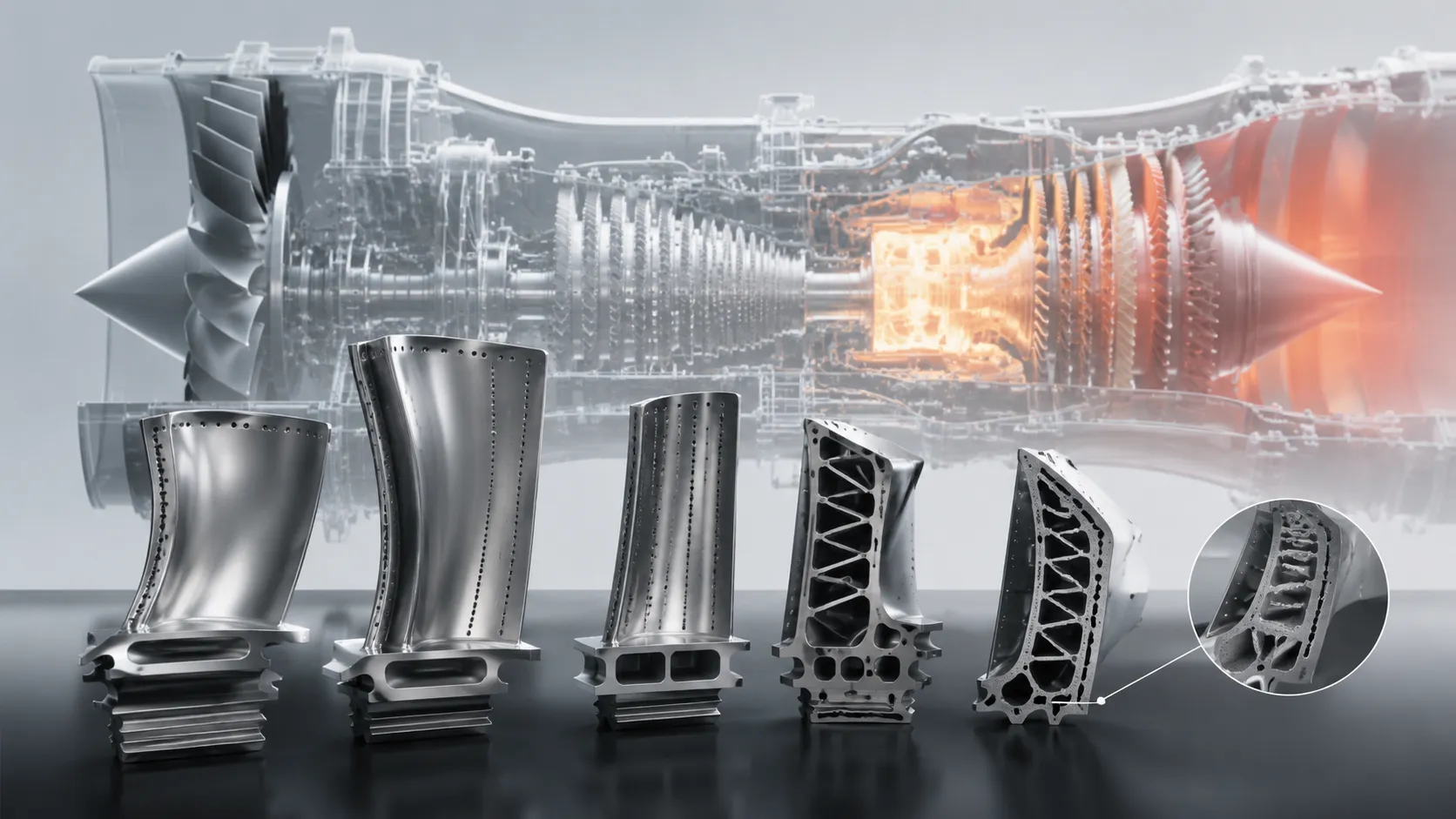
A modern jet-engine turbine blade may begin as an investment-cast nickel superalloy part. It has to survive heat, stress, vibration, oxidation, and fatigue. Some hot-section parts require directional solidification or single-crystal structures. Many use ceramic cores to create internal cooling passages. The blade’s performance depends on shape, alloy chemistry, grain structure, coating, defect rate, and inspection. Final assembly cannot rescue a bad blade. The part survives the engine or it fails there.
Investment casting gives aerospace engineers shapes and material properties that machining alone often cannot. It lets them place material for strength, remove material for airflow and cooling, and build parts that balance weight, heat, stress, and manufacturability.
That is why companies like Precision Castparts, PCC Airfoils, Howmet Aerospace, and Doncasters matter. They live in the layer of the aerospace supply chain most people never see. Precision Castparts describes itself as a market leader in complex structural investment castings, airfoil castings, forged components, aerostructures, and critical aerospace fasteners.⁴ PCC Airfoils makes turbine-engine investment castings, including blades, vanes, shrouds, heat shields, and fairings.⁵ Doncasters, founded in 1778, makes blades and vanes for aerospace engines and industrial gas turbines.⁶
A process thousands of years old can still decide whether a modern jet engine ships on time.
The Foundry-to-Flight Supply Chain
Aerospace casting is not “foundry makes part, Boeing installs part.” It is a relay race and long chain of specialized steps.
Before a part reaches an engine or airframe, it may pass through alloy selection, tooling, wax patterns, ceramic shells, melting, pouring, controlled cooling, shell removal, cutoff, grinding, heat treatment, hot isostatic pressing, non-destructive testing, machining, coating, CMM inspection, certification, and customer approval.
Each handoff can create or hide a problem.
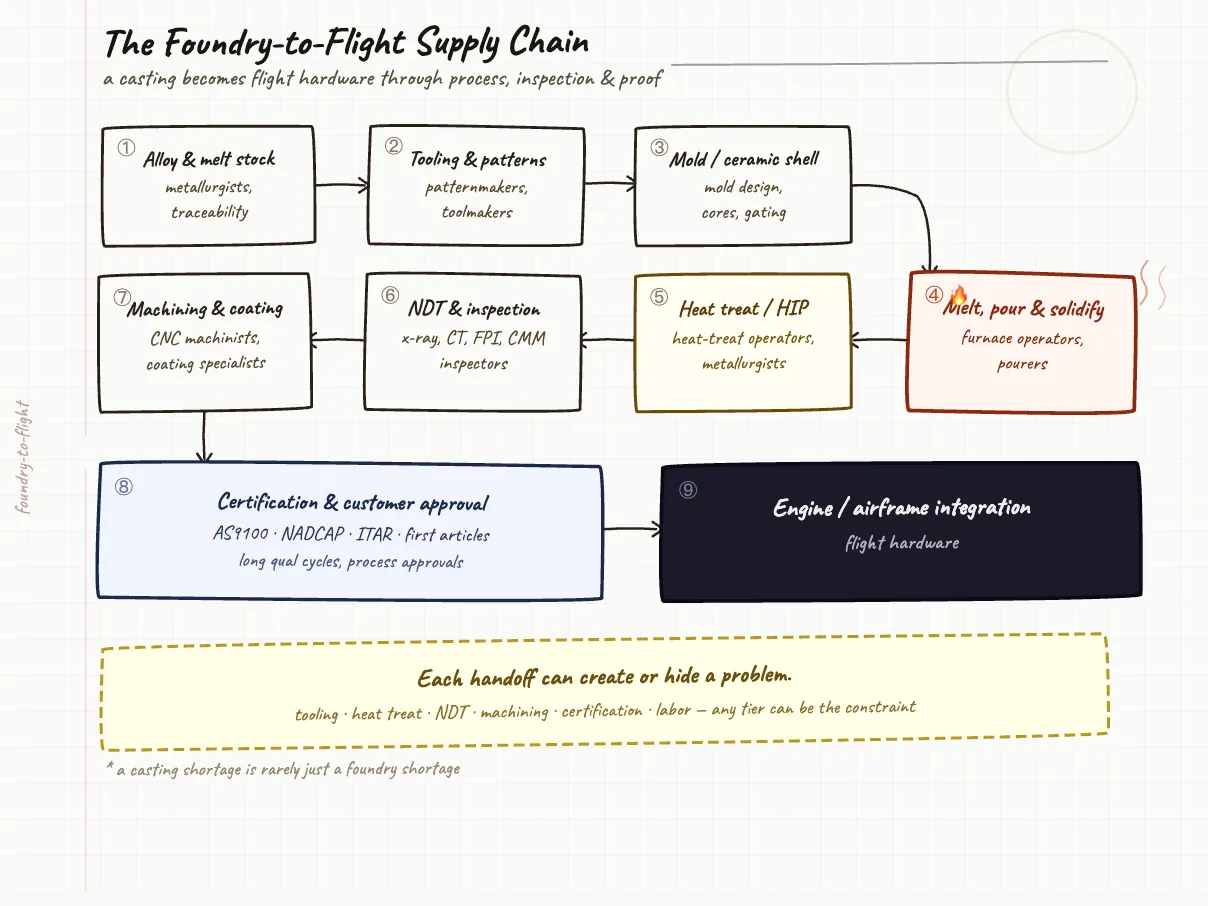
The tooling determines whether the part can be made the same way twice. The mold determines how metal flows, cools, shrinks, tears, and traps gas. Gating and risers sound like foundry vocabulary until the wrong design creates porosity, inclusions, shrinkage, or scrap.
The melt determines chemistry. The pour determines how that chemistry enters the mold. Solidification determines microstructure. Heat treatment changes the final properties after the part has already taken shape. HIP can close internal porosity in high-performance castings and improve fatigue life.
Inspection begins where eyesight ends. X-ray, CT scanning, ultrasonic testing, fluorescent penetrant inspection, magnetic particle inspection, and CMM measurement turn hidden defects into visible facts. Machining then turns near-net shape into final tolerance. Coatings add another layer of performance. Certification ties the whole history of the part to a spec, a process, a customer, and a flight-critical system.
This is why aerospace casting is slow to move and hard to substitute. A new supplier cannot simply “make the part.” It has to prove the process. In aerospace and defense, that usually means AS9100, NADCAP, ITAR controls, material traceability, first articles, customer audits, and months or years of qualification.
By the time a casting appears as a component on someone’s bill of materials, the important work has already happened.
The Chokepoint Nobody Sees Until It Breaks
BCG has called foundries and forges a critical chokepoint for new aircraft production and aftermarket service.⁷ Anyone who has seen the process will understand why.
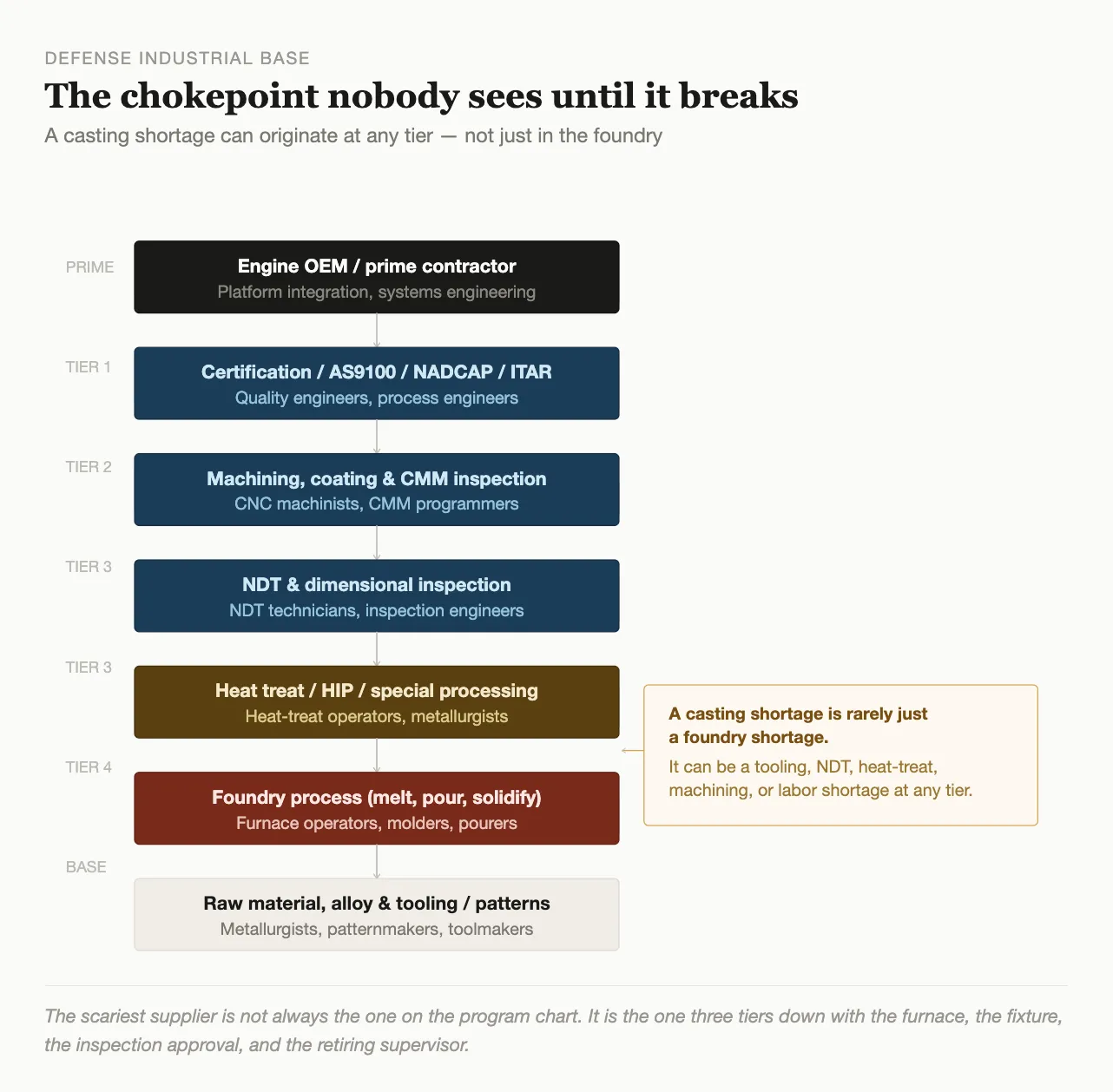
Casting and forging capacity is hard to add quickly. A supplier needs furnaces, presses, tooling, molds, qualified processes, inspection capability, skilled operators, engineers, maintenance technicians, and customer approvals. Even after the equipment is installed, the process has to be proven. The customer has to trust it. The part has to pass.
Problems also move upstream and downstream in strange ways. A bad wax pattern can become a bad shell. A bad shell can become a bad pour. A bad pour can become scrap. A heat-treat issue can ruin a part that looked fine. A machining mistake can destroy weeks of upstream work. An inspection bottleneck can hold up good parts as surely as a quality problem holds up bad ones.
That is why a casting shortage is rarely just a foundry shortage. It can be a tooling shortage, a heat-treat shortage, an NDT shortage, a machining shortage, a certification shortage, or a labor shortage hiding three tiers below the company whose name is on the aircraft.
The turbine blade example makes this real. In 2024, Safran pointed to production-yield issues involving Howmet-supplied high-pressure turbine blades as one of the problems affecting LEAP engine deliveries. Those engines power Boeing 737 MAX aircraft and much of the Airbus A320neo family.⁸ A yield issue on one component became part of the story of aircraft deliveries at the top of the aerospace pyramid.
That is the leverage of casting.
A part can be small enough to fit in your hand and still large enough to move an entire production schedule.
The People Who Know the Process
The labor gap in casting and forging is bigger than a shortage of machinists.
Machinists matter. So do furnace operators, molders, pourers, patternmakers, grinders, maintenance technicians, industrial electricians, toolmakers, CNC programmers, quality inspectors, CMM programmers, NDT technicians, heat-treat operators, metallurgists, process engineers, manufacturing engineers, tooling engineers, and plant supervisors.
The Department of War-backed METAL initiative puts the gap at 122,000 additional skilled professionals needed in casting and forging by 2028.⁹ The number is large. The work behind the number is more important.
A foundry runs on specifics: a specific alloy, furnace, mold, customer spec, and defect history. A small change in temperature, gating, shell thickness, cooling rate, heat treatment, or machining strategy can move the quality profile of a part. The best workers know this from standing near the process. They have seen defects. They have heard machines fail. They know which problems can be fixed downstream and which ones just became scrap.
That kind of knowledge is hard to replace because it lives in people before it lives in documents.
The Department of War has started building around this. METAL is trying to create a national training network for casting and forging through apprenticeships, boot camps, online learning, and metallurgical education.
Cast in Steel attacks the same problem from another angle by putting students and early-career builders in direct contact with steelmaking, casting, design, testing, and competition.¹⁰
That is the right instinct. The solution has to live close to the process. More young people need to see foundry work before they decide it is not for them. More employers need training paths that do not depend on finding the perfect worker already fully formed. More community colleges and technical schools need equipment, instructors, and direct links to local foundries, forge shops, heat treaters, machine shops, and inspection labs.
The company side makes the problem harder. AFS says roughly 75% of U.S. metalcasting firms have fewer than 100 employees.¹¹ Many are family-owned, regional, and essential. Many also lack the recruiting machines, training budgets, and brand recognition of the primes they support.
This matters for defense. The prime contractor may never hire a foundry operator. The platform still depends on one. A missile, ship, aircraft, or engine can be slowed by a supplier three tiers down with a qualified process, a full backlog, and too few people who know how to run it.
GAO has warned that DoW still has limited visibility into many lower-tier suppliers, including raw-material and parts suppliers.¹² That is where much of the real industrial base lives: the foundry, the forge, the heat treater, the NDT lab, the machine shop, the coating shop, the inspector, the retiring supervisor.
Primes assemble capability. Lower-tier suppliers make it possible.
America is trying to rebuild this chain after decades of letting pieces of it thin out. China spent those same decades building density across the industrial middle.
China Understood the Industrial Middle
America spent decades treating the industrial middle as a place to save money. China treated it as a place to build power.
The industrial middle is the layer between raw material and final assembly: steel mills, aluminum producers, foundries, forge shops, heat treaters, machine-tool builders, pattern shops, welding bays, inspection labs, industrial parks, logistics networks, and technical schools. It is where material becomes parts, and parts become capacity.
Casting lives in this layer. A foundry needs metal, refractory, patterns, tooling, furnaces, maintenance talent, metallurgists, machinists, inspectors, and customers with enough volume to keep the process alive. Volume matters because production is a learning system. More pours create more operators. More operators create more supervisors. More defects create more process knowledge. More demand creates more suppliers. Capacity improves when it is used.
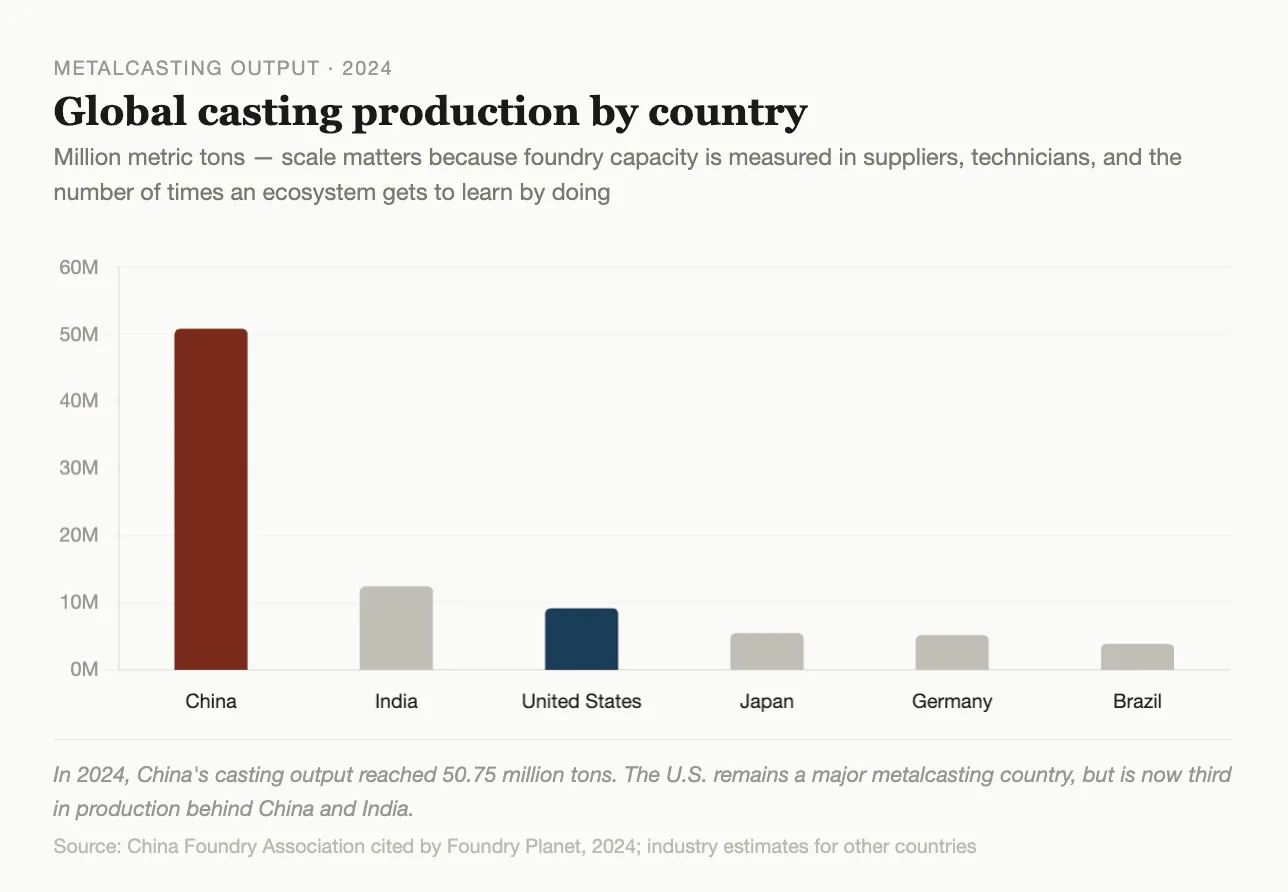
In 2024, China’s casting output reached 50.75 million tons, according to figures from the China Foundry Association cited by Foundry Planet. The U.S. remains a major metalcasting country, but AFS says it now ranks third in production behind China and India.¹³ The gap is not just tons. It is people, suppliers, equipment vendors, tooling shops, inspection capacity, and repetition.
Shipbuilding makes the pattern easier to see. In 2024, China captured more than 53% of global commercial shipbuilding market share. The United States accounted for 0.1%. CSIS also reported that one Chinese state-owned shipbuilding giant, CSSC, built more commercial vessels by tonnage in 2024 than the entire U.S. shipbuilding industry has built since World War II.¹⁴
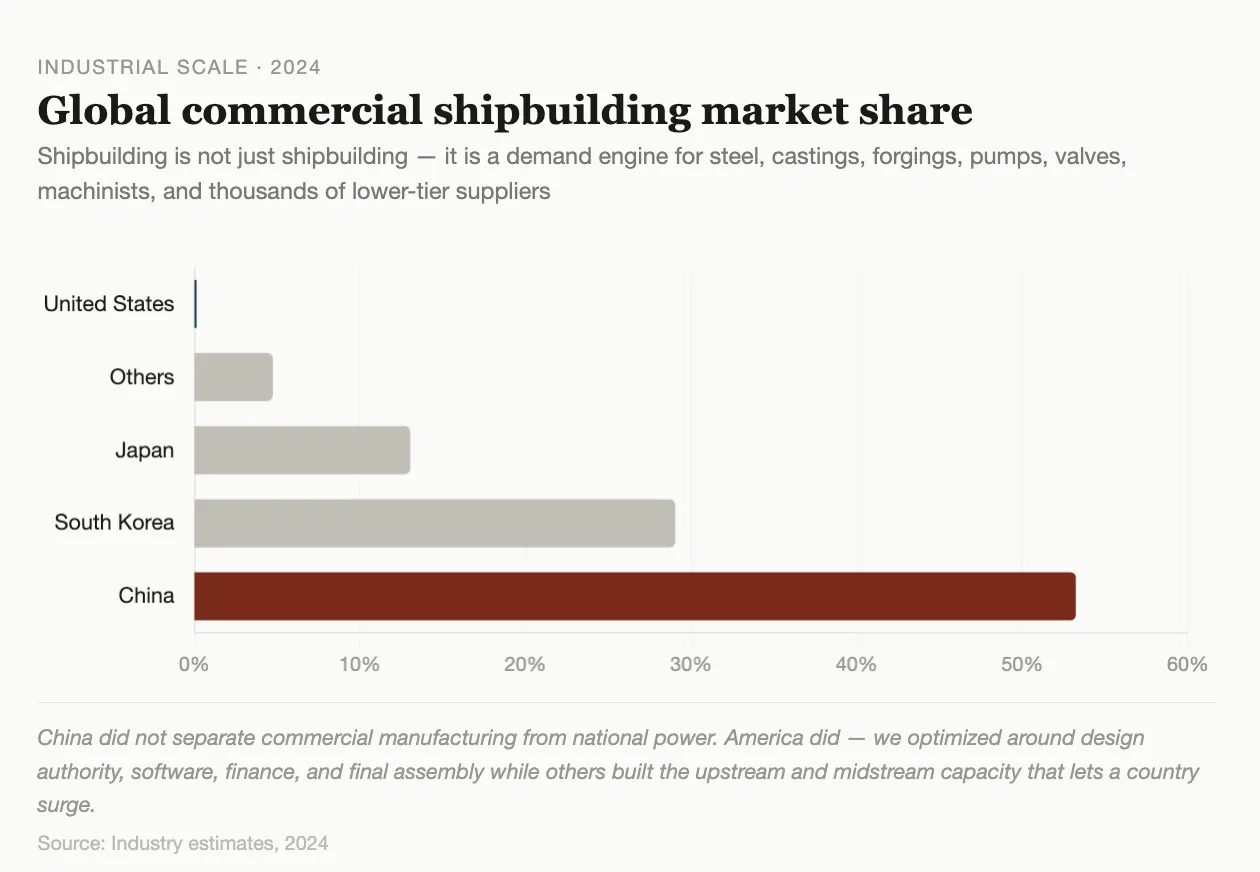
A ship is a demand engine for the industrial middle. Steel plate. Castings. Forgings. Pumps. Valves. Propulsion systems. Gearboxes. Controls. Coatings. Welders. Machinists. Electricians. Inspectors. Thousands of suppliers get pulled into motion by a healthy shipbuilding base.
Commercial volume matters here. It keeps suppliers warm. It trains workers. It gives shops repetitions. It lets the same industrial commons serve both commercial and naval demand. When commercial shipbuilding disappears, the defense base loses more than shipyards. It loses the supplier density around them.
America still has world-class primes, engineers, defense programs, and advanced technology. But primes pull on a network below them. If that network is thin, the prime looks strong until it needs a part no one can make fast enough.
China’s advantage is repetition at scale. Steel near shipyards. Foundries near machine shops. Machine shops near equipment vendors. Workers moving through plants. Suppliers learning because work keeps showing up. The system remembers because it is used.
America is trying to rebuild parts of this system now. That is good. It will take more than procurement. It will take demand, training, capital equipment, supplier visibility, technical schools, and a culture that treats hard industrial work as national capacity.
Rebuilding starts with a simple premise: the future cannot be assembled if the middle of the supply chain is gone.
What Rebuilding Actually Requires
Finishing where we started: castings sit inside roughly 90% of manufactured durable goods.¹ They are everywhere, usually hidden by the machines they make possible.
Rebuilding this base will take money. Billions over time. Foundries need modern furnaces, cleaner processes, automation, robotics, simulation, better inspection, stronger maintenance, and safer shops. Forge shops need presses, dies, heat treat capacity, controls, and skilled operators. Machine shops need equipment, programmers, inspectors, and enough demand to justify training people before the perfect worker exists.
Policy has a role. The Department of War has already started treating casting and forging as an industrial-base problem through METAL, Cast in Steel, and other efforts aimed at workforce, training, and supplier capacity.² A small foundry cannot rebuild a national supply chain by itself. It needs customers who value resilience, government buyers who understand lower-tier suppliers, lenders who understand equipment-heavy businesses, and schools that know which skills local industry actually needs.
Training has to move closer to the work. More young people need to see a foundry before they decide it is not for them. More community colleges need equipment that looks like the equipment in the plants around them. More employers need apprenticeship paths that turn curiosity into skill. More students need to learn that metallurgy, machining, maintenance, quality, and inspection are serious careers.
Startups have a role too. Some will make inspection faster. Some will help foundries quote work, schedule jobs, reduce scrap, recruit workers, train operators, and predict maintenance failures. Some will use AI and simulation to help engineers design better castings before metal ever hits the mold. The best tools will make the best workers more powerful.
This is already happening in pieces. A technical school adds a program. A foundry buys new equipment. A defense initiative funds a training network. A startup builds software for an old workflow. A manufacturer brings work back from overseas. A young person walks into a plant and realizes the physical world is still a place to build a life.
That is enough to make me optimistic.
Notes
[1] American Foundry Society: U.S. metalcasting is a $51B industry, directly provides more than 160,000 jobs, indirectly supports more than 300,000 supply-chain jobs, and castings are used in 90% of manufactured durable goods. https://www.afsinc.org/industry-statistics
[2] DOE / OSTI market research on metal casting: U.S. metalcasting facilities declined from 6,150 in 1955 to 3,200 in 1991 and roughly 1,750 in 2020. https://science.osti.gov/-/media/sbir/pdf/Market-Research/AMO—Metal-Casting-August-2022-Public.pdf
[3] PCC Airfoils: investment casting processes, ceramic cores, solidification technology, computer modeling, inspection methods, and blades/vanes for aircraft and industrial engine segments. https://www.pccairfoils.com/about/
[4] Precision Castparts: market position across complex structural investment castings, airfoil castings, forged components, aerostructures, and critical aerospace fasteners. https://www.precast.com/
[5] PCC Airfoils: complex highly technical investment castings for turbine-engine applications, including turbine blades and vanes. https://www.pccairfoils.com/
[6] Reuters: Doncasters, founded in 1778, produces complex components such as blades and vanes for aerospace engines and industrial gas turbines. https://www.reuters.com/business/aerospace-defense/aerospace-parts-maker-doncasters-raises-9193-million-us-ipo-2026-06-25/
[7] BCG: foundries and forges are a critical chokepoint for new aircraft production and aftermarket servicing. https://www.bcg.com/publications/2024/fixing-aerospaces-supply-chain-for-casting-and-forging
[8] Reuters: Safran identified Howmet Aerospace as the supplier tied to production issues slowing LEAP engine delivery, centered on high-pressure turbine blade yield. https://www.reuters.com/business/aerospace-defense/us-supplier-howmet-under-spotlight-over-airbus-engine-delays-2024-07-31/
[9] IACMI / DoD: METAL was established in response to DoD’s identification of a need for an additional 122,000 skilled personnel in essential casting and forging roles by 2028. https://www.iacmi.org/iacmi-dod-new-partnerships-to-combat-workforce-shortages-in-u-s-casting-and-forging-industry/
[10] American Foundry Society: about 75% of U.S. metalcasting firms have fewer than 100 employees. https://www.afsinc.org/industry-statistics
[11] GAO: DoD’s supply-chain visibility efforts remain limited in scope and provide little insight into the vast majority of suppliers, including those providing raw materials and parts. https://www.gao.gov/products/gao-25-107283
[12] American Foundry Society: the U.S. is the third-largest supplier of castings in the world, after China and India. https://www.afsinc.org/importance-metalcasting-0
[13] CSIS: China captured over 53% of global commercial shipbuilding market share in 2024 while the U.S. accounted for 0.1%; CSSC built more commercial vessels by tonnage in 2024 than the entire U.S. shipbuilding industry has built since World War II. https://www.csis.org/analysis/are-us-policies-eroding-chinas-dominance-shipbuilding